
Recently, the creative weeks have been bleeding in to one another, each becoming less distinct. I have found that I have been hopping back to previous poems – as a write new ones, they seem to breathe new life and meaning into lines that I kept locked away in my journal from week 1. Additionally, some weeks I have drawn a card that I have not immediately been able to write for, and so I have had to carry that card over with me to the following week, hoping to keep mining my own brain for something poignant.
While I have found this to be a bit frustrating, it is probably a good thing. I have quite a strong desire to compartmentalise, and to tick things off my to-do list.I think this is because I’ve absorbed toxic interpretations of what it means to be “productive” as a creative practitioner. If I am not producing enough “content” out of this residency, I will be a failure…that sort of thing.
Unfortunately, performance and deadline anxiety, while catalysts for some, tend to have a paralysing impact on me. So, the last few weeks have largely revolved around me encouraging myself to breathe, relax, and let go of what is effectively a self-inflicted stress. While I strongly believe that the arts should be taken seriously, I also know that creation (for me) needs to feel like play. For those who observe the pagan calendar, which I have begun doing recently, this letting go of the heaviness of pressure and overwhelm is quite timely. I am told that Imbolc, usually celebrated between 31st March and 2nd Feb, or alternatively on the first new moon of February, is a time to look forward to the spring that lingers not far off. It’s a festival of hope, held at the midpoint between the winter solstice and the spring equinox, indicating that our seasons have firmly tipped towards a warmer era of growth and expansion.
I have spent more time outside in the last few weeks, allowing myself the space and time for my ideas and feelings to take physical shape. This tipping towards spring can be felt not just in the change of temperature but, strangely, in the quality of the air. Everything feels clearer, and while there still undoubtedly lingers the threat of frost, the earth has started to erupt in snowdrops and crocus.
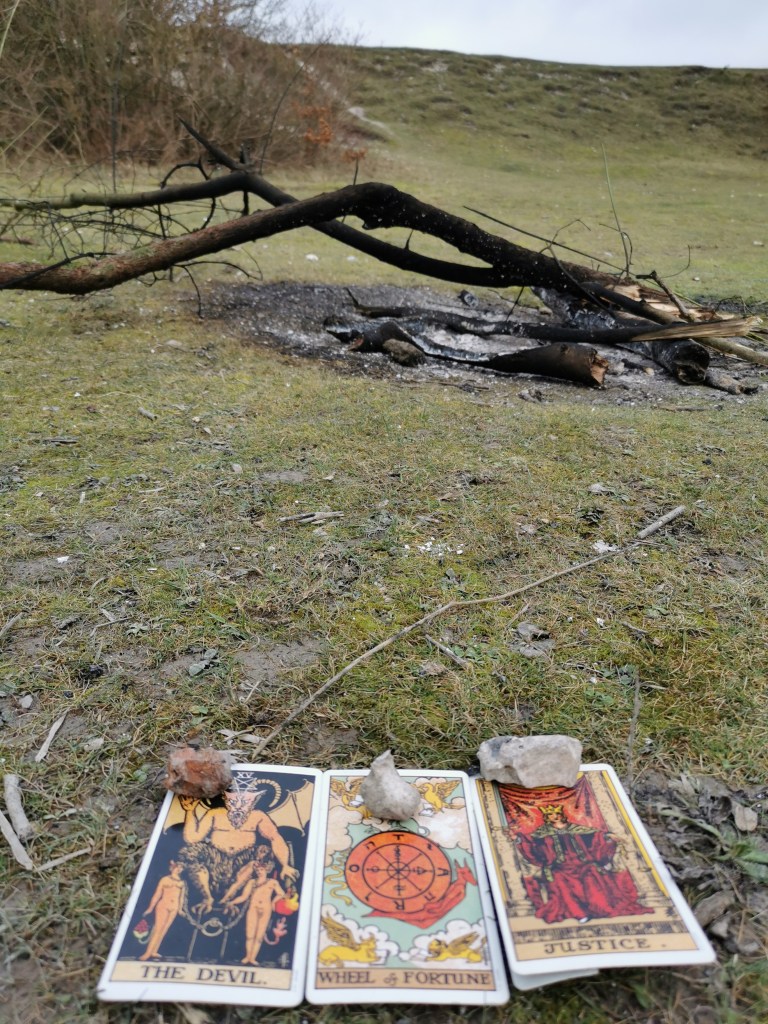
There is a place near where I live called The Fairy Ring. It sits above a chalk quarry on the edge of the South Downs, overlooking the river Ouse. One Tuesday I decided to head there with Panda and the tarot cards I am working with. At the exact moment that I laid the cards in front of me, and drew my notebook out to start to write, I noticed that the peregrines have returned.
Carved into the chalk quarry below where this photo was taken is a peregrine nest. We observed them from various angles last year, amazed firstly by their quite undignified calling (which is of a much shriller variety than their buzzard and eagle cousins) and secondly by the patience and commitment they show to their young. The dedicated parents feed and encourage growth in their nervous chicks for up to 6 months, waiting for the inevitable: first flight, and first hunt. Evidently, mating pairs (who are usually monogamous for life) also return to the same nesting spot year after year.
I found in this falcon-tale, a nice correspondence with the Wheel of Fortune, which is often read as relating to cycles, but also with fate and the inevitable.
I find the young peregrines’ reticence to leave the nest to be very relatable. Change and growth, as we all know, can be hard (especially when that growth involves launching ones self from the side of a cliff with a sheer drop below). However, it is also inevitable – in the case of these peregrines, a fearsome predator and the fastest bird on the planet, flight and the hunt is in the very fibres of their biology – it is their fate, if you like.
Peregrines have symbolic meaning in many cultures and spiritual systems. Broadly speaking, they often represent freedom, vision, and victory. Making connections with my observation of these birds and their symbolic significance, I find affinity in some of my own formative experiences. I can still remember the fear and pain I felt when I was trying to leave an incredibly harmful and toxic relationship – as with all major change, launching into the unknown is uncomfortable, and my confidence during this relationship had been systematically eroded. I did not know if I was enough to exist on my own. For far too long, that fear of inadequacy was paralysing, and thus deeply harmful.
To get to the right headspace where I was able to leave, I found myself repeating affirmations over and over again. Here, I note a mirroring in the cyclical and repetitive nature of The Wheel of Fortune, and also of the peregrine lifestyle, in their patience, their returning, their (self)nurturing, and their focus.
The poem developed from The Wheel of Fortune explores these themes, and aims to provide space to vocalise a commonality in experiences and feelings, acknowledging the ways in which these can speak across species boundaries.
As with every week of this experience, I continue to reflect on the creative process generally. Sharing writing – any writing, but perhaps particularly writing that draws on personal experience – is incredibly scary. As I have mentioned to colleagues (and in this blog) repeatedly, I have battled with imposter syndrome and stage fright throughout this process. My notebook is littered with impulsive asides: “I keep waiting to feel like I am enough”, “I don’t want to be seen”, “I am afraid.”
I am coming to realise, however, that choosing to share my work is not dissimilar to the first step I took out of that relationship, or the first motions the young birds take out of their nest. It is nothing more and nothing less than allowing yourself the permission to just be who you are, actualised and whole. Fear of failure, of inadequacy, or of getting it wrong can be life-impacting. However, they are also fears that have more to do with the phrases that have been repeated to us, or that we repeat to ourselves, than they do with any lived reality. That a young peregrine still fears to do what it is, by biology, perfectly equipped for, can give any of us comfort!
Few of us will face the same consequences for failure as a baby bird does – the stakes for us are nowhere near as high. However, there is a lesson in the letting go, and in the inevitable end point of our drives to be ourselves.
The Wheel of Fortune ties many of these connections together, ending:
survival // is nothing more // than a well executed fall // that no-one can outrun
 Alice O'Malley-Woods
Leave a comment