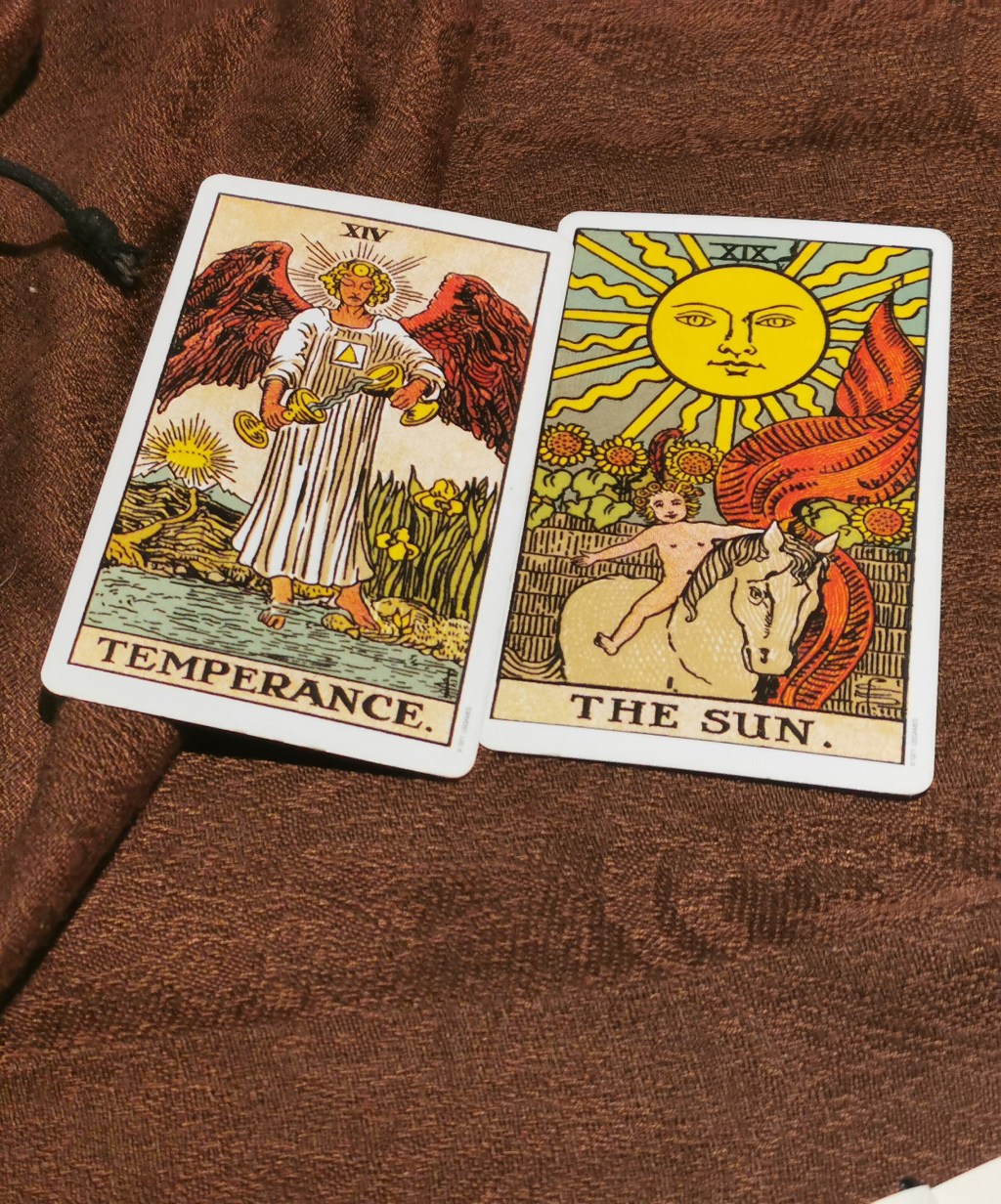
During my residency at Treadwell’s, I am aiming to create a collection of poetry thematically centred around the Major Arcana of the tarot. I have chosen to use the Rider-Waite-Smith deck, as this is the deck I was introduced to when I was still a child. It is the deck I would often find spread enticingly across the kitchen table of the old, damp, critter-bursting cottage my brother and I spent the foundational stages of our childhood in. Too young to really understand the meanings and implications of the cards, I was nevertheless drawn to the images, and also the social and cultural space created around them as my mother and her closest friends read together, and shared the ups and downs of their lives.
Our time in this home, though geographically extremely isolated, was one I now remember as deeply communal. My brother and I were borderline feral at times, finding non-human companions and allies outside of the home on a daily basis. We would take it in turns to stalk and track each other, and in doing so learned the intimate shape of every field, every ditch to hide in, every tussock to conceal a messy head. We worked out which trees were best to climb for effective vantage points, which were welcoming of our climbing, and which were hostile. We named the young cows over the wall at the end of the garden, and got to know their differing personalities. For educative reasons that I now can’t quite remember, we decided to collect different kinds of animal poo that we kept tucked inside notebooks. Our swimming lessons were self-directed and fully-clothed, in the surf.
Thanks to the regularity of kitchen table spreads, accompanied by hot coffee and angel cake, the warmth of my memories of this place and time are imbued with the visual symbologies of tarot. It is therefore unsurprising that, when I turned towards writing around The Sun and Temperance, the first two cards I drew as part of this creative project, my writing directed itself towards memories of “home”.
In The Sun (the cards are also the titles of the corresponding poems, poetry is indicated by italics), I found myself reflecting on the vitality of this earlier part of my life; a vitality that, for me, was very much found through our constant interaction with non-human animals and plants, and the depth of our attachment to place. Subsequently, I also reflected on a sense of self that was lost when we left that home to move onto the council estate on the outskirts of a neighbouring town. While this new home had undeniable positives (it was warm and dry, had human neighbours, access to public transport, and a shop within walking distance) it signified a drastic change in lifestyle which we were unprepared for, to say the least. I was suddenly plagued with an acute sense of unbelonging that, in many ways, I still feel – this coincided with my movement out of childhood and through adolescence, and so very much reflects the battle of the wild/domestic associated with gender role expectations I referenced in my previous post.
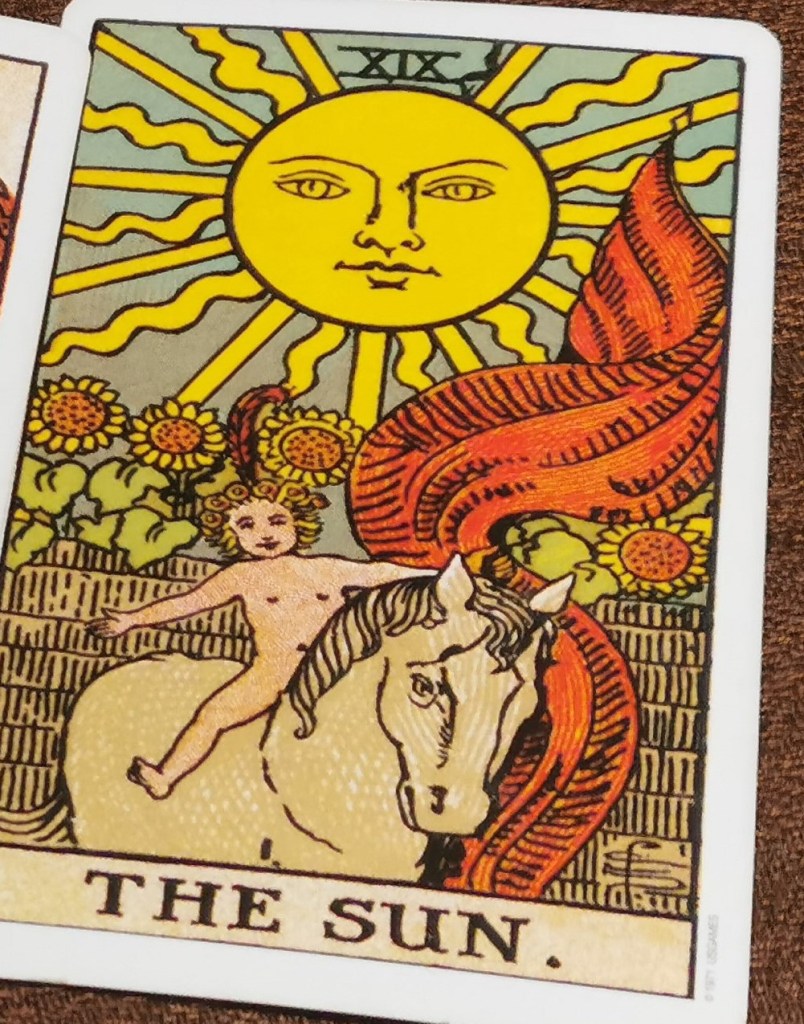
The Sun celebrates the vitality of childhood, but ends with a promise to continue this vitality though other life stages: ‘If I lie in tall grass / unseen, my legs / become the meadow / go to seed. Root-run and tangle.’
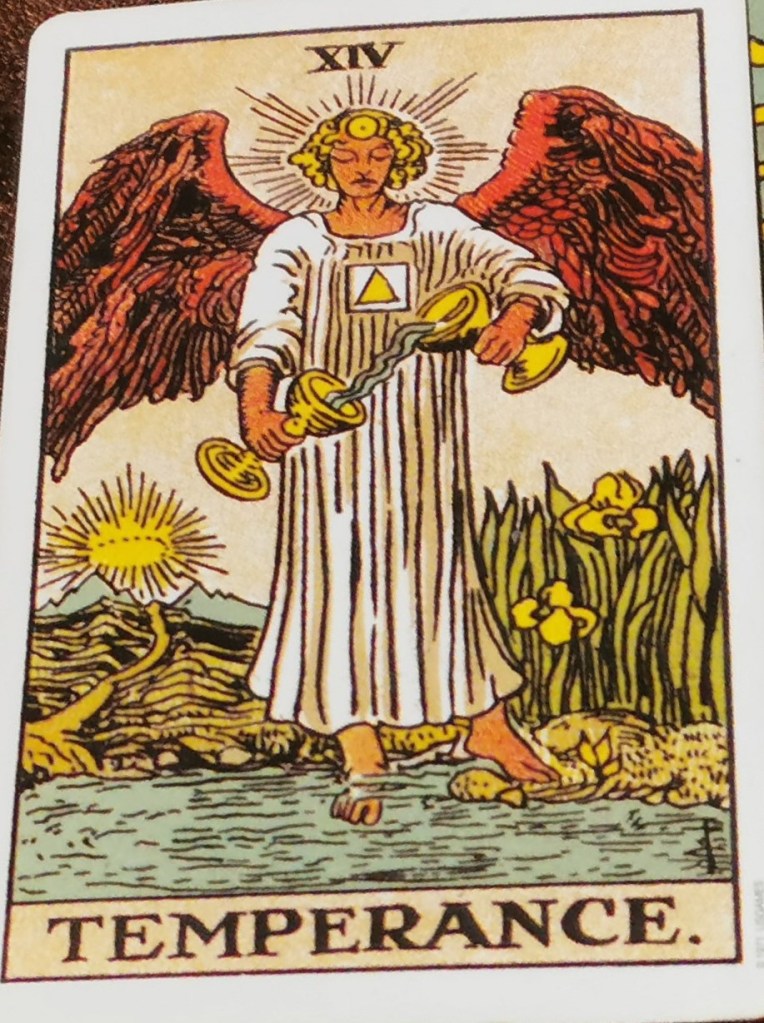
Temperance equally finds some reckoning with the past in order to frame an ecological life in the present. The figure in the Rider-Waite-Smith depiction of Temperance reminds me instantly of my mother standing over the washing up bowl at our new home after we left the cottage. I remember my mum being particularly house-proud during this time; she was dedicated to creating a beautiful home in our new surroundings, and for her that meant cleanliness. As a disabled single parent suffering with chronic pain, completing chores often meant pushing past discomfort. There is deep concentration on the face of the figure on the card Temperance, and it is the same expression I often saw on my mum, as she made her way through the cups and bowls of water. I wanted to find a way of balancing my intuitive and memory-based reaction to this card with the widely-accepted meaning. Simply read, the card is one of balance and harmony, however, as a much appreciated tarot reader informed me while I was in the shop, Temperance is also associated with alchemy.
As I was ruminating on all of this, a visual image of the marshland where Panda and I walk kept pushing into my mind. I had written down a few sentences recently, about how miraculous it feels that the marshes can be dark, boggy, peaty spaces for what seems like weeks. Then, literally overnight, can transform into huge, fresh, loch-like bodies of water, complete with the arrival of waterbirds. The appearance of all of this beautiful water never fails to delight both me and Panda – it’s like waking up to find snow. Then, after a day or two of dry, we can return to the same place to find our lakes have disappeared, replaced by solid fields.
All of this shifting of water (my mother’s care and home-making through cleaning, Temperance’s moving of water between cups, and the marshes great swelling and receding) are examples of alchemical work; balancing, harmonising, tranquilizing.
In Temperance I do my best to tie together card, memoir, and land-relationship, to reflect on the often gendered nature of care and healing: ‘How baffling / that Earth still manages / to force up something clean/ to wipe mouths / baptise cups. / That we manage to sink / and to resurface, to endeavour / to bring into this lonely house / something made new / and new, and new.’
I would love to share the full poems I am developing here. Unfortunately, I aim to publish, and so I’m unable to do so. I will be holding a reading at Treadwell’s the end of March, however, so if you’re interested in hearing more about my work, and how I’m understanding these poems, please do come along.
 Alice O'Malley-Woods
Leave a comment